Equine viral arteritis: how to spot and report the disease
How to spot equine viral arteritis, what to do if you suspect it and measures to prevent its spread.
Applies to England, Scotland and Wales
Equine viral arteritis (EVA) affects horses, donkeys and other equids.
It does not affect humans.
Equine viral arteritis is a notifiable disease in:
- stallions (male horses)
- mares (female horses) that have mated or been inseminated within 14 days
If you suspect the disease you must report it immediately by calling the Defra Rural Services Helpline on 03000 200 301. In Wales, contact 0300 303 8268. In Scotland, contact your local Field Services Office. Failure to do so is an offence.
Latest situation
Four cases of equine viral arteritis were confirmed in non-thoroughbred stallions on closely linked premises in Dorset and Devon in April and May 2019. One of the cases has now been resolved as the stallion was exported in June 2019.
A fifth case, unrelated to the earlier outbreak, was confirmed in a non-thoroughbred stallion on a premises in Shropshire on 31 July 2019. This case has now been resolved as the stallion was castrated in August 2019.
We’ve published epidemiology reports summarising the investigations by APHA to control these incidents.
There is no risk to public health.
Restrictions on breeding and movement have been put in place on the animals to limit the risk of the disease spreading and further investigations are ongoing.
If you keep horses you should follow our guidance on preventing equine viral arteritis.
How to spot equine viral arteritis
Advice on spotting the signs, how the disease is spread and how you can help prevent it is available in this poster:
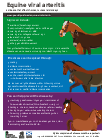
Signs of equine viral arteritis can include:
- abortions (failed pregnancies in mares)
- conjunctivitis (bloody tissue around the eye known as ‘pink eye’)
- watery eyes
- swelling of testicles or udder, also around eyes and lower legs
- fever and runny nose
- depression
- anorexia (without appetite)
- lethargy and stiff movement
Many infected horses will show no clinical signs. In rare cases the disease can cause severe clinical signs or death in young foals.
How equine viral arteritis is spread
Equine viral arteritis can be spread through:
- mating
- artificial insemination
- contact with aborted foetuses
- contaminated equipment and materials
- droplets on the breath of infected animals for up to 2 weeks
Stallions can carry the disease for extended periods without showing clinical signs. They can spread the disease through sexual contact or if their semen is used to artificially inseminate a mare.
Mares can spread the disease during pregnancy to their foals, or through milk, or to a stallion from further mating.
Preventing and controlling equine viral arteritis
You can help prevent the disease by following the guidance in the Horserace Betting Levy Board (HBLB) Code of Practice.
You should:
- practise good biosecurity on your premises, especially if you’re involved in breeding
- test all stallions, teasers and mares before breeding
- consider vaccinating stallions against the disease - talk to your vet for advice
- follow guidance on isolation and testing when importing horses
Biosecurity guidance is also available on the BEVA website.
If you suspect equine viral arteritis
You must:
- isolate any animals you think are affected
- stop the suspect animals mating
- report your suspicions to the Defra Rural Services Helpline on 03000 200 301 and an APHA vet will investigate
If equine viral arteritis is confirmed
If equine viral arteritis is confirmed the outbreak will be controlled in line with the contingency plan for exotic notifiable diseases.
If equine viral arteritis is confirmed in a stallion, it will remain under breeding restrictions until the risk is mitigated. This can be done through castration, export or repeated tests showing that it no longer has the virus. Until the risk has been mitigated, the stallion cannot be used for breeding except under licence from APHA.
In order to mitigate the risk of disease spreading, the infected stallion may be named and its location publicised.
You should follow the recommendations in the Horserace Betting Levy Board (HBLB) Code of Practice. This includes, testing all horses on the premises, even if they have not been bred with the infected animal since equine viral arteritis can also be spread via contaminated equipment and materials and through droplets on the breath of recently infected animals.
Equine viral arteritis infected stallions
The stallion named below is considered to be a possible breeding risk to unvaccinated mares and an infection risk to other horses through contact with contaminated equipment or materials. This animal cannot be used for breeding or semen collection unless licenced by the Animal & Plant Health Agency.
| Name | Horse passport | Microchip | Location |
|---|---|---|---|
| Lago Icon | 7240151202GB625 | 9851 7000 2128 903 | Stokelake, Newton Abbot, Devon, TQ13 0EH |
Further information on prevention and control
What happens when a notifiable disease is suspected or confirmed
Legislation relating to equine viral arteritis
Equine viral arteritis is covered by the Equine Viral Arteritis Order 1995.
Last updated 15 August 2019 + show all updates
-
Added information on how the disease will be controlled in an infected stallion. Also updated the content under the 'Latest situation' heading.
-
Additional link to new epidem report
-
Added information about the fifth case of EVA.
-
Updated the latest situation section as there has been a confirmed case in Devon. Also added the poster on spotting signs.
-
Updated the guidance on how to prevent the disease.
-
Added information about a third case of equine viral arteritis.
-
Minor changes under the 'How to spot equine viral arteritis' heading.
-
Added information about the 2 confirmed cases of Equine Viral Arteritis in Dorset.
-
Contact details for reporting a notifiable disease updated.
-
First published.